
Find your migraine profile in under 60 seconds.
Answer 8 quick questions and we'll send you a personalized plan — built for your body, your triggers, and what you've already tried.
- ✓Personalized plan based on your specific pattern
- ✓Built by headache specialists
- ✓8 questions · about 60 seconds
By continuing, you agree to our Terms of Use and Privacy Policy.
Choose your gender
How old are you?
What does a migraine feel like for you?
Pick all that apply
What sets yours off?
Pick all that apply
Here's what your answers are telling us.
Reading your answers…
The combination you're describing — your symptoms alongside your triggers — isn't random. And it's not "just stress."
This pattern almost always shares a single underlying driver — ignored by most care plans.
We'll get to that in a moment. A few more questions first.
What's your attack frequency like?
What have you tried?
Pick all that apply
When you've tried things that didn't work, what usually happened?
Are you currently pregnant, breastfeeding, or trying to conceive?
Your plan is ready. Where should we send it?
Building your plan…
- Matching your pattern…
- Choosing your trust signals…
- Pulling stories from people like you…

Based on your answers, Mighty® — our daily migraine supplement — is built for your pattern.
You're getting your migraine days, mostly set off by your top triggers. You've already tried some things. That's the most common pattern we see — and it's not your fault. It's the dose.

"This product made a difference almost immediately. I went from 15–20 debilitating attacks a month to one in the first month of taking Mighty. I've tried everything in 20 years of being a sufferer — seriously, everything — and this works. It's truly a life-saver."

"I've had chronic head pain for 24 years and this is the first time I've felt relief in years. After going off my preventative medication to find natural relief, I was struggling with 20+ days a month — until I found Mighty. 3 weeks in, I haven't had a single attack. I finally have my life back."

"I started getting severe migraines with visual aura at 49 — 2–3 a week. Neurologist, botulinum injections, sumatriptan, ubrogepant. 6 months and $5,000 got me nowhere. After 10 weeks on Mighty I'm down to 1–2 mild a month — many months I'm migraine-free. A life saver."
You're already doing the Rx work. Mighty is the daily foundation underneath.
Prescription preventives like CGRP inhibitors and Botox treat the firing — they don't refuel the cells. Mighty layers safely on top: twelve clinically-studied actives that fill the micronutrient gaps research links to migraine resilience. Designed to layer with your current Rx, not replace it.
You weren't wrong to try supplements. The dose and form were.
Most over-the-counter supplements use cheap, poorly-absorbed forms — drugstore magnesium gives your body about 4% absorption. The B2 in a typical multivitamin is 1.7 mg, while the dose used in the actual migraine trial is 400 mg — over 200× higher. Mighty® fixes both, in one jar, alongside ten other active ingredients that work together. Here's the side-by-side:
OTC pain relievers numb the alarm. Mighty stops it from going off.
Reaching for ibuprofen or Excedrin every other day treats the pain after it starts — it doesn't touch why it's starting so often. (And too many can trigger rebound headaches.) Mighty is built to lower baseline frequency so you reach for the OTC bottle less often. Twelve active ingredients, one jar, dosed at the levels published research actually supports.



Six of those active ingredients map directly to what your quiz answers told us — including your symptoms, your triggers, and your common pattern:



Migraine is an energy problem in your brain.
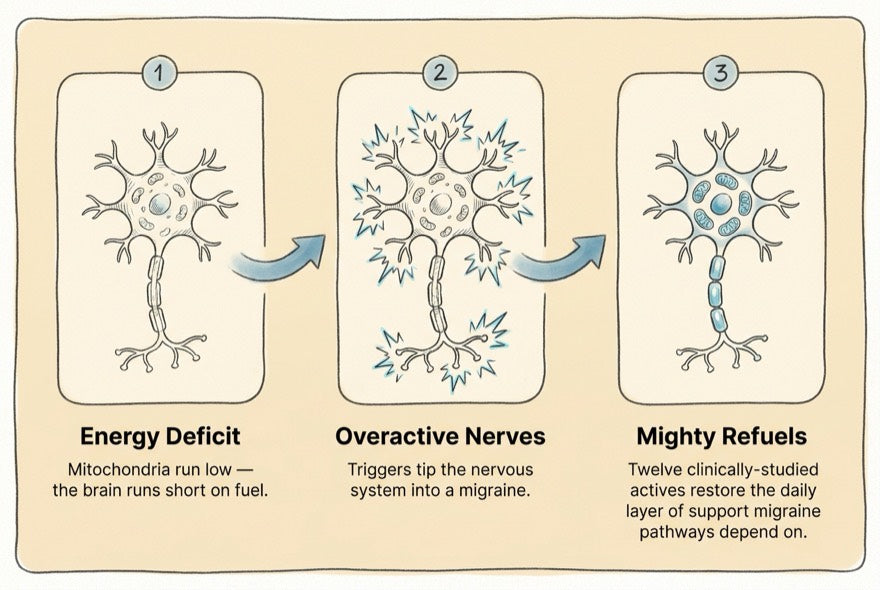
When your brain runs low on energy — under stress, sleep changes, or hormones — your nervous system gets hypersensitive. That's the migraine. The pain isn't the problem; it's the alarm going off.
Your Rx silences the alarm.
Mighty® supports a healthy brain that fires it less often.
Other treatments silence the alarm.
Mighty® supports a healthy brain that never sets it off.
OTC relievers numb the alarm.
Mighty® supports a healthy brain that fires it less often.
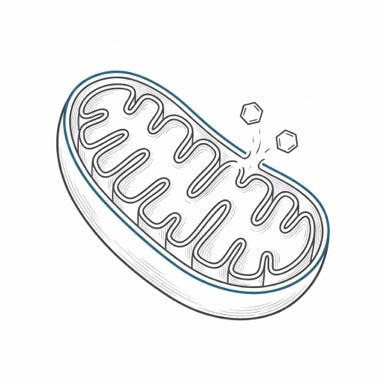
Recharge your brain's energy supply.
Migraine brains run an energy deficit. Mighty® refuels the mitochondria with riboflavin 400 mg (the Schoenen 1998 trial dose), CoQ-10, and Acetyl-L-Carnitine.
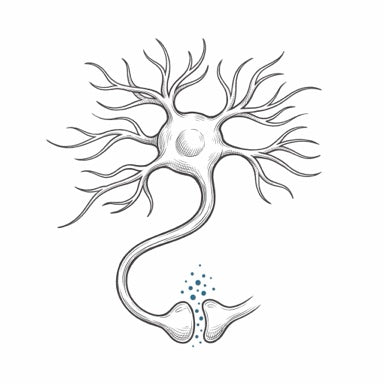
Calm an over-firing brain.
Half of chronic migraine sufferers run low on magnesium. Mighty's chelated glycinate (10× better absorbed than oxide) plus active B6 and methylfolate raise the threshold before a brain tips into attack.

Soften the inflammatory cascade.
Inflammation turns a manageable trigger into a full attack. Standardized feverfew (300 mg, trial dose), Vitamin D3, and zinc target the cascade at the source.
Customer photos, sent in from real Mighty® mornings.


Where your pattern is now. Where it could be by Day 90.
Curves modeled on published prevention trials of the actives in Mighty®, dosed at study levels. In those trials, the first signal typically appears around Day 30, with continued response through Day 90.
A typical month — before Mighty, and 90 days in.

Your answers tell me you've been through the prescription gauntlet — and you're still searching. I built Mighty as the daily nutritional foundation that layers safely with what your neurologist already has you on. No interactions, no replacement — just the missing layer.
Try a 90-day trial of Mighty. If it's not working alongside your Rx, we refund every cent — no return required.
Your answers look a lot like what we faced in our own home a few years ago. After six years of trial and error — magnesium alone, B2 alone, every blend at the vitamin shop — my family and I built the formula we take every morning. That's Mighty®.
You don't have to take my word for it. Try a 90-day trial of Mighty. If it's not working, we refund every cent — no return required.
If you're reaching for Excedrin or ibuprofen every other day, I get it — that was me too. The OTC bottle gets you through the moment, but it doesn't lower the baseline. Mighty is built to do exactly that.
Try a 90-day trial of Mighty. If your migraine days don't drop, we refund every cent — no return required.
People whose answers looked a lot like yours.
I'd cycled through topiramate, propranolol, and now a CGRP inhibitor. Each one helped and stalled. My headache specialist said the Rx was doing its job — but my baseline nutrition was the gap. Two months on Mighty and I'm down from 9 days a month to 3. No interactions, no new side effects.
My CGRP inhibitor was solid for 3 weeks of the month — and useless the week before my period. Adding Mighty closed that gap. Two cycles in a row without a hormonal attack.
Botox handled my baseline but my luteal-phase attacks were untouched. Mighty layered on top, and now my cycle weeks read like the rest of the month.
Triptans for breakthroughs and a daily Rx weren't enough through perimenopause. Mighty layered in cleanly — my OB approved — and I've reclaimed roughly 6 days a month.
I was at 12 days a month even on a CGRP inhibitor. My headache specialist OK'd adding Mighty. After 10 weeks I was at 4 days. The Rx alone wasn't enough — this was the missing layer.
Topiramate took me from 18 to 10 migraine days a month and stalled there. Mighty pushed me to 3-4. No interactions, no new side effects.
Quarterly Botox + propranolol got me to ~8 days. Layering Mighty pushed me into the 3-5 range — first time I've seen that number in years.
Topiramate made me foggy. Propranolol crashed my BP. I needed something I could layer that wouldn't give me one more side effect to manage. Mighty delivered — clean.
I'd cycled through three preventives before someone suggested layering a real supplement. Mighty was the first that didn't fight my Rx — and the only one that moved the needle.
I asked my neurologist about supplements alongside my CGRP inhibitor. He told me to look for therapeutic doses of magnesium glycinate, B2, and CoQ-10. Mighty was the only single jar that hit all three.
I've tried everything in 20 years. Magnesium on its own. B2 on its own. Every blend at the vitamin shop. None of them stuck. With Mighty, I went from 15–20 debilitating attacks a month to one in the first month. It's truly a life-saver.
I was taking magnesium, B2, and CoQ-10 from three different bottles, mostly trying to survive my hormonal week. Mighty replaced all three at higher doses — and my cycle migraines went from 4 days to one mild one.
I had 6 separate supplements lined up every morning, all aimed at my cycle migraines. Mighty consolidated them and the doses were finally at the levels I'd been Googling about for years.
I'd tried two of the popular migraine blends. Same outcome — a guaranteed attack the day before my period. By the third month on Mighty, that day passed without an attack. I cried.
I've tried everything in 20 years. Magnesium alone. B2 alone. Every blend at the vitamin shop. None of them stuck. Mighty took me from 15-20 debilitating attacks a month to one. It's truly a life-saver.
I was getting around 10 attacks a month, mostly when work stress hit. I'd cycled through magnesium and a multi for years with no real change. By week 4 on Mighty I was at 2/mo.
I'd lost count of the migraine supplements I'd tried. None of them dosed magnesium glycinate or B2 anywhere near the trial level. Mighty was my last attempt — and the first that actually worked.
Every short night of sleep ended in an attack the next afternoon. I'd been taking magnesium and B2 separately and it wasn't moving the needle. After 6 weeks on Mighty, I get poor nights without an attack following.
I had a cabinet — literally — of single-ingredient supplements I'd accumulated. Mighty replaced all of them at better doses, and my attacks dropped at the same time. Strange feeling — finally fewer pills AND fewer attacks.
Two migraine blends, a multivitamin, magnesium on the side — none of it really moved the dial. The doses on Mighty are different. That's the whole story.

I'd been managing attacks reactively for years. Excedrin every other day, sometimes more. I never tried a daily supplement because nothing seemed to work for friends who had. Mighty was different — by week 6, my migraine days dropped from 10 a month to 3, and I'd stopped reaching for the OTC bottle.
I'd take Excedrin for 3-4 days every cycle like clockwork. Started Mighty as a daily and the next cycle was the lightest I've had in a decade. Two more cycles since — same pattern.
I never thought a daily supplement could actually help — I just figured cycle migraines were the price of being female. Mighty convinced me otherwise. Last cycle I forgot the Advil bottle existed.
I'd been a Tylenol-and-ice-pack person for 15 years on cycle days. Two months on Mighty and I had a period that wasn't capped by an attack. Took me a few days to trust it.
I was popping Excedrin so often I started worrying about rebound. Mighty was the first daily supplement I'd ever tried. 90 days in, I might reach for the OTC once a week, max.
I knew I was overdoing the ibuprofen but didn't know what else to do. Mighty got me to a place where I just don't need it most days. My doctor was relieved.
I was hitting 15 migraine days a month, all managed with Excedrin Migraine. The rebound was getting worse than the attacks. Mighty dropped me to ~5 in 90 days. I'm a different person.
I always thought a daily supplement was only for "serious" cases. Took me ~5 weeks to feel the shift on Mighty, and now I get why people stick with it.
I'd written off supplements years ago after a generic mag/B2 combo did nothing. Mighty is dosed completely differently. Three weeks in, I knew this was different.
I didn't want to be on Excedrin for the rest of my life. Mighty gave me an off-ramp. The first month was steady; by month two I noticed I just… wasn't reaching for the bottle.
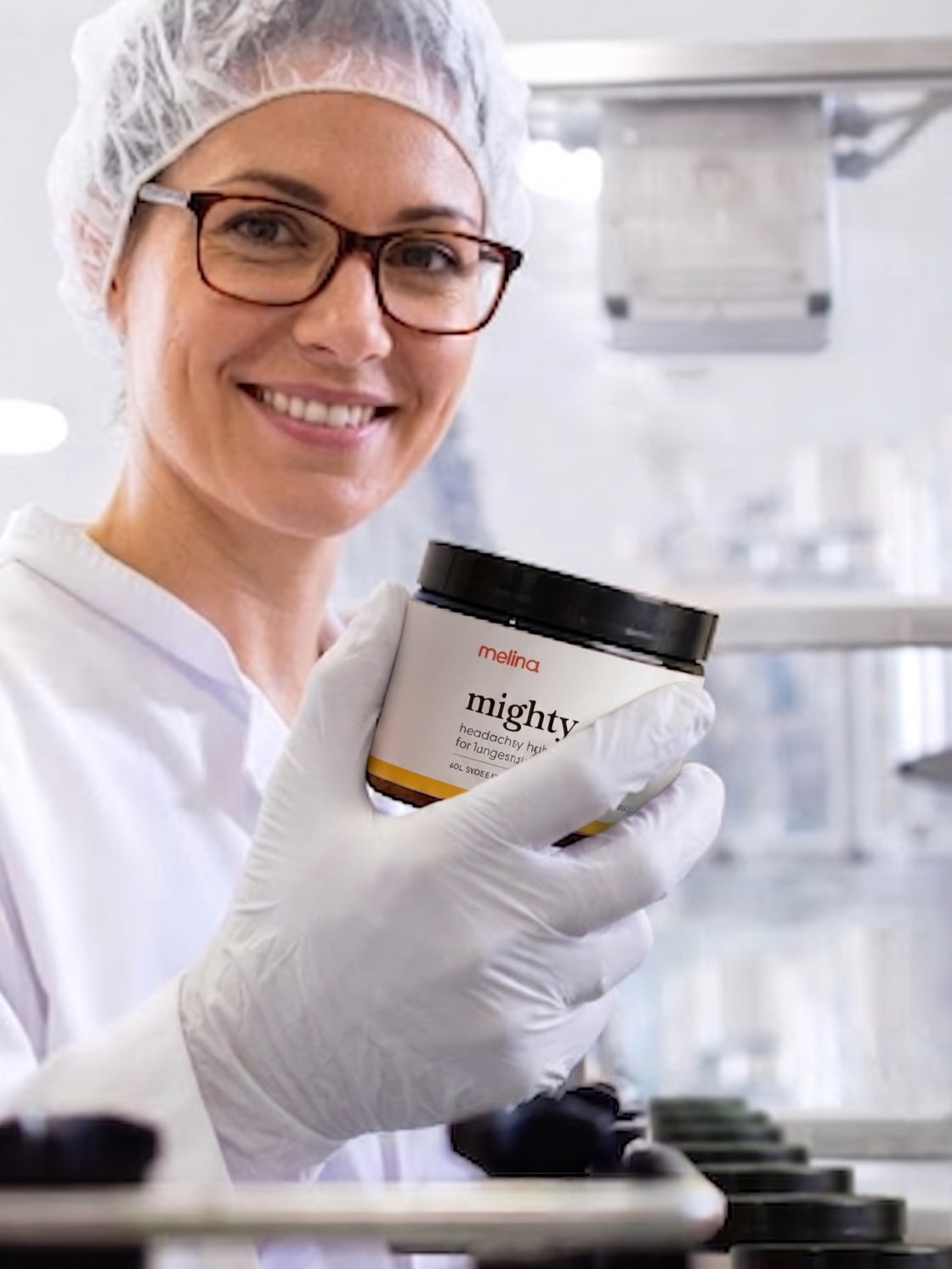
Made in Utah. Triple-tested. Built in cGMP-certified facilities.
Mighty® is blended in FDA-registered, cGMP-certified U.S. facilities and goes through a 3X testing protocol. Every batch is reviewed against the published research the formula's actives are based on.
 📍 Made in Utah, USA
 🧪 3rd Party Tested
Every active is checked for identity and purity before production. Off-spec batches get rejected.
Dose uniformity and capsule weight verified during blending — every serving matches the trial dose.
Finished jars are tested for heavy metals, microbial contaminants, and California Prop 65 compliance.
 All-natural ingredients
 Blended in the USA
 Vegetarian friendly
 Non-GMO
 No major allergens


Mighty Daily Migraine Formula®
Built for someone with your pattern.
Designed to layer alongside your prescription — no known interactions with CGRP inhibitors, triptans, propranolol, or Botox. Twelve active ingredients at the doses migraine research supports, filling the daily nutritional gap your Rx doesn't cover.
One jar replaces magnesium, B2, CoQ-10, feverfew, and methylfolate — at the doses the research supports, not the under-dosed amounts in most blends. Twelve clinically-studied actives in one jar, in the ratios that matter.
Daily support — built to lower your baseline so you reach for OTC less often. Twelve active ingredients in one jar including magnesium glycinate (250mg) and riboflavin (400mg) at the clinical trial dose.
Try Mighty® for 90 days. If you don't see fewer migraine days, our team refunds every cent — one email, no phone tree, no return shipping.
Questions worth answering before you start.
For your situationI've already tried supplements for migraines. Why is this different?
Two reasons most over-the-counter options miss the mark:
- Wrong form. Drugstore magnesium is usually oxide — your gut absorbs about 4% of it. The form Mighty® uses (glycinate) absorbs about 40%.
- Wrong dose. The B2 in a typical multivitamin is 1.7 mg. The dose used in the actual migraine clinical trial (Schoenen 1998) is 400 mg — over 200× higher.
Mighty® fixes both, plus adds 10 other active ingredients that work alongside them — particularly CoQ-10 and Acetyl-L-Carnitine for cellular energy, and feverfew for the inflammatory side.
How soon will I notice a difference?
- Weeks 3–4: the first reductions usually show up — slightly shorter or less intense attacks.
- Weeks 8–12: the bigger shift, fewer total migraine days per month.
The active ingredients need that long to build up in your system and for your brain cells to start running on a fuller tank.
Can I take it with my current medications?
Yes. Mighty® is built to layer cleanly with the common migraine prescriptions:
- CGRP inhibitors
- Triptans (acute relief)
- Beta-blockers like propranolol
- Topiramate
- Botulinum toxin injections
It's a daily science-backed nutritional supplement. Always check with your doctor first.
What if it doesn't work for me?
Is 4 capsules a day a lot?
Your Mighty® plan in one place.

- ✓12 active ingredients at the doses used in published migraine trials
- ✓Built to layer with anything else you're already taking
- ✓Most customers see fewer migraine days between weeks 4 and 12
- ✓90-day guarantee — full refund, no questions asked
What's in Mighty

Lab results (all passed)

- ✓Heavy metals
- ✓Microbials
- ✓Potency
- ✓Prop 65 compliant
Mighty isn't right for you right now — and we're glad you told us.
You shared that you're pregnant, breastfeeding, or trying to conceive. Migraines during this stage are real, exhausting, and often under-treated — and you deserve real help. But Mighty contains a few ingredients that don't have enough safety data for pregnancy, lactation, or conception, so we won't sell it to you in good conscience. Here's what we'd tell our own family in your shoes.
Three of our ingredients don't pass the bar for this stage.
We won't ask you to roll the dice on incomplete safety data. Here's specifically what's in Mighty and why each one is a concern.
Feverfew has uterotonic effects — it can stimulate uterine contractions. It's traditionally been used in folk medicine to bring on menstruation, which is why every credible pregnancy reference flags it as contraindicated during pregnancy and cautions against it while trying to conceive (the early-implantation window is fragile, and most people don't know they're pregnant in the first 4–6 weeks).
Riboflavin is essential and routinely included in prenatals. The issue is the dose. The pregnancy RDA is about 1.4 mg/day; Mighty contains 400 mg — the dose used in clinical migraine-prevention trials, which excluded pregnant participants. There's no established upper limit in pregnancy because the studies haven't been done. We won't be the ones to find out.
Both are well-tolerated in non-pregnant adults and there's some emerging research suggesting CoQ-10 may even be supportive in certain pregnancy contexts. But the published safety data in pregnancy and breastfeeding is thin. Without robust trials in this population, we don't think the right answer is "probably fine."
Migraine support that's safer-rated for this stage.
None of this is medical advice — every body is different and your OB/midwife/neurologist needs to be the one signing off. But here's what's well-documented and frequently used during pregnancy and breastfeeding.
Magnesium has the strongest pregnancy-safety profile of any migraine-relevant supplement — it's even used clinically at much higher doses for eclampsia. The glycinate form is the gentlest on the gut. Common starting dose is 200–300 mg/day. Run the exact dose by your provider, especially in the third trimester.
B6 is routinely prescribed for pregnancy nausea and is well-tolerated. There's some evidence it modestly helps migraine. Typical pregnancy doses are 10–25 mg/day; the upper limit during pregnancy is around 100 mg/day. Don't exceed without provider sign-off.
Most prenatal vitamins contain D3 already. Migraine and low D status are correlated, and pregnancy guidelines often recommend D3 supplementation. Check your prenatal label and ask your provider before stacking additional D3.
Sleep, hydration, regular meals (skipped meals are a top trigger), cold compresses, and cervical/temple acupressure all have decent evidence and zero safety risk.
If you're getting migraines often enough to take this quiz, you deserve a real conversation with your OB or a headache specialist. Some preventive medications are considered relatively safer in pregnancy than others; some are clearly off the table. This is exactly the conversation a specialist is trained for.
Most migraine supplements aren't built for this.
If you're shopping, scan the label for these. The supplement industry is not regulated for pregnancy safety, and many "natural" migraine blends quietly include ingredients you'd want to avoid.
Same reason as Mighty — uterotonic, contraindicated in pregnancy. It's in most "migraine herbal" blends because it's effective. That's exactly why it's the first thing to check the ingredient list for.
Some products still include butterbur for migraine. Even the "PA-free" extracts have flagged liver-toxicity and pregnancy-safety concerns. Most major medical organizations do not recommend butterbur during pregnancy.
If a label shows riboflavin/B2 above ~25 mg, it's at "migraine prevention dose," not the prenatal dose. The studies that established that dose excluded pregnancy.
Sometimes added as a "natural pain reliever." It's chemically similar to aspirin — and aspirin is generally avoided in pregnancy (especially the third trimester) without provider direction.
If a label hides exact doses behind a "proprietary blend," you literally cannot know what you're ingesting at what dose. That's not a chance worth taking when you're pregnant or breastfeeding.
Talk to your provider this week.
If migraines are running your life right now, and you're pregnant or trying to be: that conversation is overdue. Migraine specialists, OB/GYNs, and certified nurse-midwives all manage this routinely. There are real options — non-pharmaceutical, lower-risk pharmaceutical, lifestyle-led — that fit your stage of pregnancy.
The single biggest favor you can do for yourself: take this quiz with you. The pattern you described is more clinical detail than most providers get in a 15-minute appointment.
Questions other parents have asked us.
What if I've already taken Mighty before I got pregnant?
Can I take Mighty during breastfeeding?
When can I start Mighty after the baby comes?
I'm just trying to conceive — am I really at risk this early?
Does Melina make a pregnancy-safe migraine product?
This page is informational and is not medical advice. Talk to your healthcare provider about migraine treatment during pregnancy, lactation, or conception. Mighty has not been evaluated for use during these periods and is not recommended for use during them.
- Choosing a selection results in a full page refresh.
- Opens in a new window.